Basics & Guides
What is an LLM? Large Language Models explained simply
ChatGPT, Claude, Gemini — they all are based on "Large Language Models." How these models work, why they are sometimes wrong, and what this means for corporate use.
Behind every AI chatbot is a "Large Language Model," or LLM for short. Those who understand how it works at its core make better decisions when using it: from setting realistic expectations to crafting the right prompt.
An LLM predicts the next word
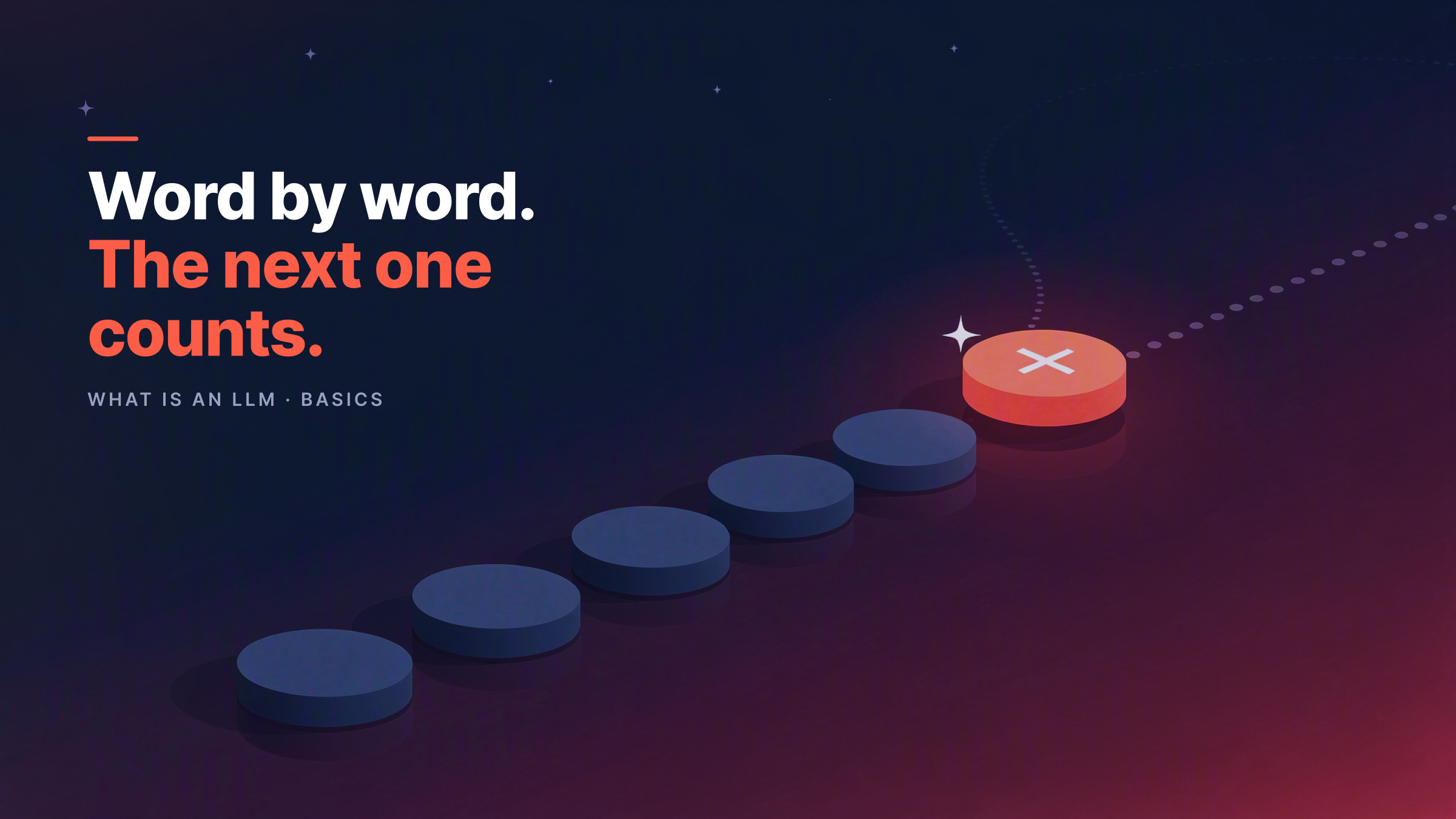
As astonishing as the results are, the basic principle is surprisingly simple. An LLM was trained on vast amounts of text and learned which words are likely to follow one another in a given context. With every response, it calculates step by step the respectivemost likely next piece of text— Token by token, until a complete text is created:
A "token" in this context is a unit of text—a short word or a part of a word. The key is the consistency: An LLMdoes not echoIt generates text based on learned patterns. This explains why it can formulate things so flexibly — and why it occasionally makes things up.
Why LLMs hallucinate
Because an LLM generates plausible-sounding text instead of retrieving facts, it can be convincingly wrong. Experts call this "hallucination." It is not a bug in the narrow sense, but rather a characteristic of how it functions. The most effective countermeasure within a company is to bind the model to reliable sources—which is exactly what [this/it] doesRAG, by supporting answers with evidence from real documents.
Context window: the short-term memory
Another key term is the "context window"—the amount of text that a model can consider at one time. It is a kind of short-term memory: whatever fits inside (your question, attached documents, the conversation history so far) informs the answer. Once it is full, the model loses track of earlier parts.
What this means for companies
Three practical points follow from the way it functions: first, good...Prompt Engineering, because the input strongly controls the output. Second, reliable facts require a connection to one's own knowledge. Third, the choice of model is a strategic question — including whether it is aopen, self-hosted modelacts.
For companies, it matters less which LLM is "the best" than whether it is operated in compliance with data protection regulations and connected to their own proprietary knowledge.
Conclusion
An LLM is a statistical text generator of impressive capability — not an omniscient system. Those who understand this use it more confidently. Our [guide/article/etc.] shows you how to deploy LLMs securely within your company.Guide to the AI Platform for Medium-Sized Businesses.
DSK — RAG Orientation Guide (2025)

GDPR-compliant AI from a real German data center
Kasimir runs on its own infrastructure in Germany — no detour via US providers, no CLOUD Act reach.