Basics & Guides
What is artificial intelligence? A classification for companies
AI, machine learning, deep learning, generative AI — these terms are often used interchangeably. A clear, practical classification of what they actually mean and what matters for businesses.
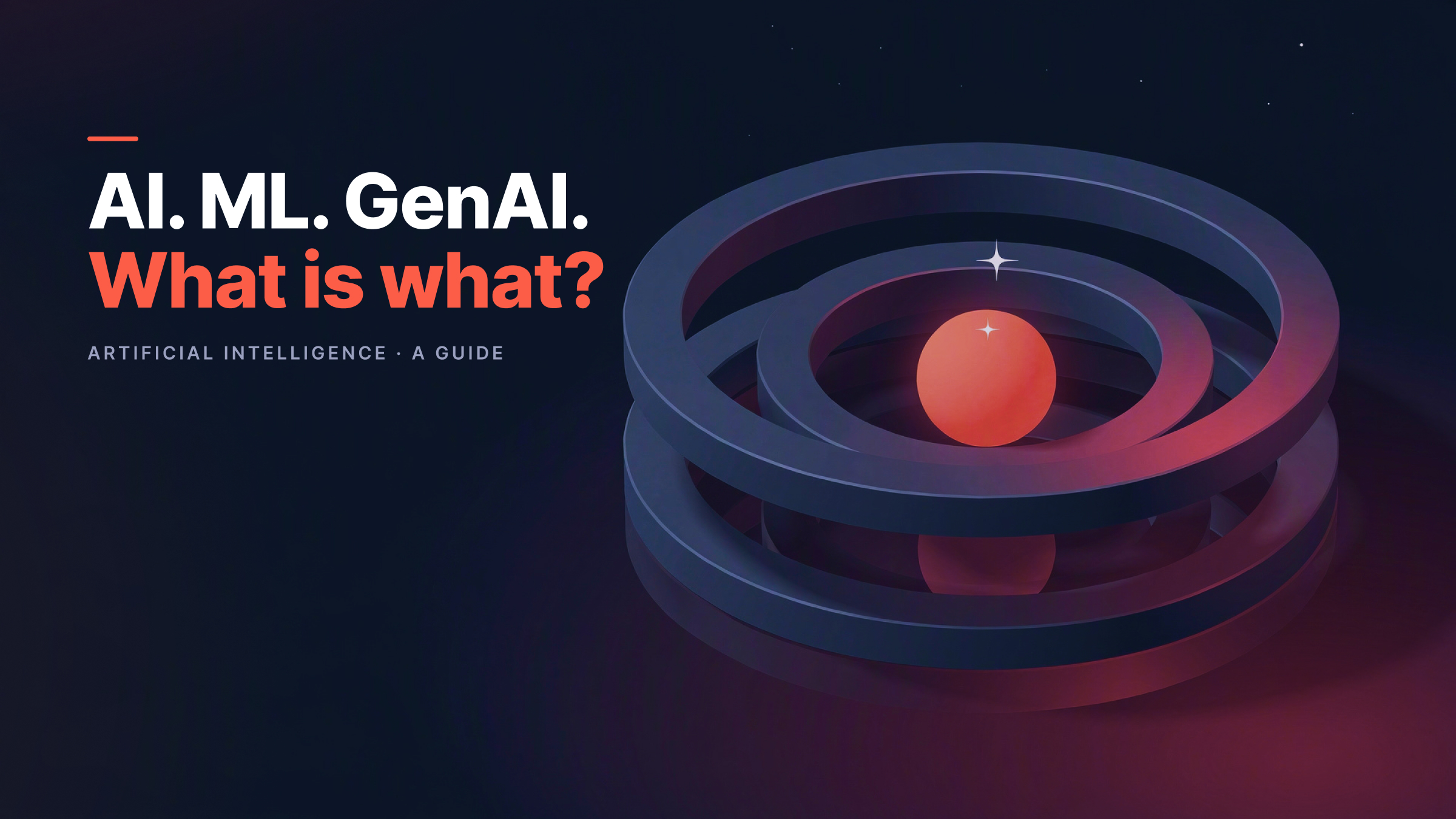
"Artificial Intelligence" has become an umbrella term under which all sorts of things are understood—from chatbots to science fiction. For companies, it is worthwhile to clarify a few terms to avoid being misled by marketing when making decisions.
Four terms, nested within each other
The easiest way to understand AI is as a series of nested fields — from the general to the specific:
Artificial Intelligenceis the umbrella term for machines that perform tasks that are commonly assumed to require human intelligence.
Machine Learningis the currently dominant approach: systems learn patterns from data instead of being rigidly programmed.
Deep Learninguses multi-layered neural networks and enabled the great leaps of recent years.
Generative AIis the newest branch: models that generate new content — text, images, code. More on this inWhat is generative AI?.
What AI can do — and what it cannot
Modern AI is astonishingly good at understanding and generating language, finding patterns in large amounts of data, and taking over routine tasks. However, it does not "understand" in the human sense—it recognizes statistical correlations. This explains both sides: the stunning performance and the errors that occur when a system confidently produces nonsense (so-calledHallucinations). For corporate use, this means: AI is a powerful tool, but not an oracle — control and traceability remain important.
What of that matters for companies
In practice, generative AI is primarily relevant for most companies—the chat assistant that writes emails, summarizes documents, and answers questions. Its value is created when it is connected to the company's own knowledge (seeRAG) and is operated in compliance with data protection regulations. Our article provides an overview of the specific toolsAI Tools for Businesses 2026.
The most important step is not to understand the technology in detail, but to make it safely usable — on a platform that provides data protection and control.
Conclusion
Artificial intelligence is not a single thing, but rather a family of methods—and for companies, what matters most is what is practically usable today. Our [guide/whitepaper/etc.] shows you how to implement AI meaningfully and securely.Guide to the AI Platform for Medium-Sized Businesses.


GDPR-compliant AI from a real German data center
Kasimir runs on its own infrastructure in Germany — no detour via US providers, no CLOUD Act reach.