AI in Business
ChatGPT Alternative for Companies: The Great Comparison
ChatGPT is the market leader — but rarely the best choice for companies. Why more and more firms are looking for European alternatives, which ones exist, and what really matters when comparing them.
ChatGPT brought generative AI into everyday work — and took Germany by storm. Bitkom President Dr. Ralf Wintergerst summarizes it as follows:
"AI has taken Germany by storm."
In the same breath, he warns that "new digital dependencies" are emerging. This is exactly where the search for alternatives begins. According to a representative Bitkom survey (2025), 68% of Germans believe the country is too dependent on the USA and China regarding AI, 60 % desire independence from US corporations — and 69 % would use a German AI provider, but only 41% would use a US-based one.
The market itself is clearly US-dominated today: ChatGPT (43%), Microsoft Copilot (39%), and Google Gemini (28%) lead in usage. The discrepancy between this reality and the desire for sovereignty is why alternatives are relevant for companies.
Why ChatGPT reaches its limits for companies
Nothing about ChatGPT is per se "insecure" — the question is the context of use. For companies, four topics converge:
Data Protection & US Transfer — the provider is subject to US law. EU data residency has only been available for ChatGPT Enterprise since 2025 and is not comprehensive; metadata continues to flow to the USA. More on this in our post on the US CLOUD Act.
Shadow AI — where an approved solution is missing, employees turn to the private app. Bitkom measures: 45% use AI with the employer's knowledge, 10% without. More on this under ChatGPT & Data Protection.
A Single Provider — at OpenAI, there are only OpenAI models. For different tasks (law, code, translation), one model may be better than another.
Costs & Governance — ChatGPT Enterprise is around 60 USD per seat per month, without central cost control across multiple models.
What makes a good corporate alternative
The decisive question is not "Which model is the best?", but "Which platform gives me control?". Five criteria:
Hosting Location & Data Protection — operation in an EU, ideally German data center, with a data processing agreement and without training on your data.
Model Variety instead of Lock-in — multiple models under one interface, the appropriate one for each task.
Transparent Costs — predictable and traceable across all users and models.
Integration — Integration with existing systems (documents, knowledge, M365/Google).
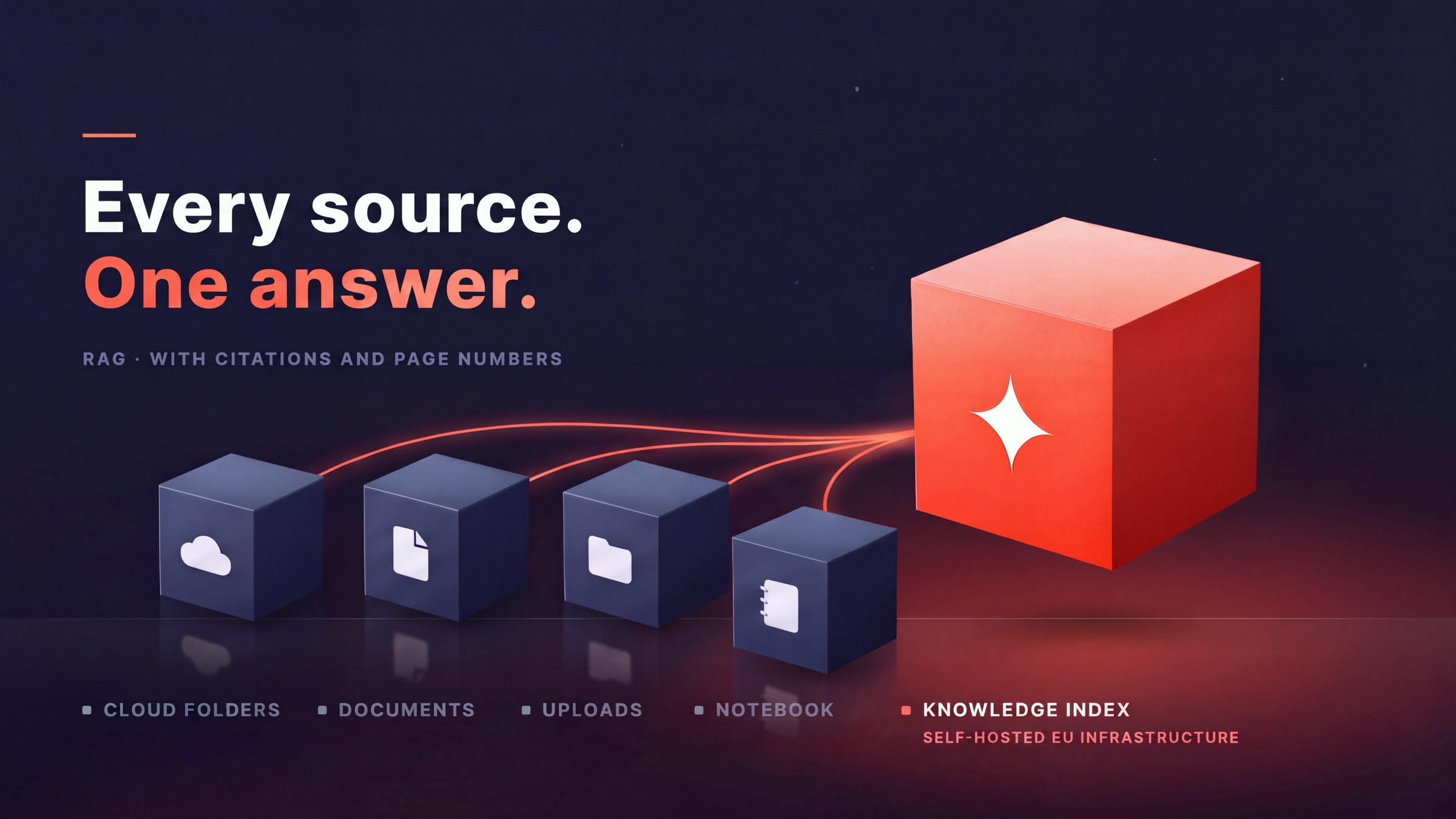
Traceability — source citations and governance for regulated industries.
An overview of European alternatives
They have existed for a long time — and they are being taken more seriously. An overview by t-online (2026) mentions several:
Mistral AI (France) — powerful open-weight models, also self-hostable; "Le Chat" as its own interface.
Aleph Alpha (Heidelberg) — focus on sovereignty and transparency with source citations per answer; fully operated in the EU, strong in the public and regulated sectors.
Proton Lumo (Switzerland) — privacy-oriented assistant from the Proton ecosystem.
Self-hosted Open Source — models of the Mistral/Llama class on own or EU infrastructure mean maximum data sovereignty.
The pragmatic middle ground for most companies is not a single model decision, but a platform, which bundles several of these models in compliance with GDPR — including open-source models in their own data center for sensitive cases and strong commercial models where pure performance is key.
Kasimir pursues exactly this approach: several AI models under one interface, operated in a German data center — without lock-in, with central governance and predictable costs.
Conclusion
“OpenAI does not train on your business data or conversations” — this applies to the Enterprise products and is important. But data processing without training is not the same as data sovereignty. Those who want control over location, models, and costs are better off with an open European platform. How to select and implement such a platform is shown in our Guide to AI Platforms for Medium-Sized Businesses — the specific data protection aspects are explored in depth in the article Data Sovereignty in the Company.
Bitkom — Employees use shadow AI (2025)
McKinsey — The State of AI 2025
GDPR-compliant AI from a real German data center
Kasimir runs on its own infrastructure in Germany — no detour via US providers, no CLOUD Act reach.